James G. Weir This web page Copyright © 2020 David G Best All rights reserved
James Galloway Weir started retailing sewing machines c1867 from premises at 2 Carlisle Street, Soho, London. He sold a range of machines including one called The American, this was actually produced by Charles Raymond, Guelph, Canada and by 1871 Weir was selling this machine under his own name as Weirs 55s sewing machine.
In 1872 Weir patented various improvements to Raymonds machine including a redesigned bobbin holder and helical gears which made the machine quieter. Initially it is thought Weir modified Raymond machines at premises in Belmont Street, London. The modified machine became Weirs 55s sewing machine and the unimproved Raymond machine was renamed The Globe and was sold for 42s.
In 1876 Weir with six others set up the Automatic Machinery Co. Ltd. The Articles of Association refer to it manufacturing every kind of machinery particularly sewing machines. Weir received 1500 shares in the new company in return for an unspecified number of family machines then being made as well as the tools used to produce them.
The establishment of the new manufacturing company effectively brought the arrangement with Charles Raymond to an end.
The location of the factory was at Ferdinand Place, Chalk Farm Road, which was also given as the address of three of the shareholders all of whom were listed as engineers. The company was not a success and at a meeting of shareholders at Fredinand Place on 24th September 1878 it was resolved that the company be voluntarily wound up. In all probability Weir would have bought up the assets of the company and continued to produce machines until he retired from the business c1889.
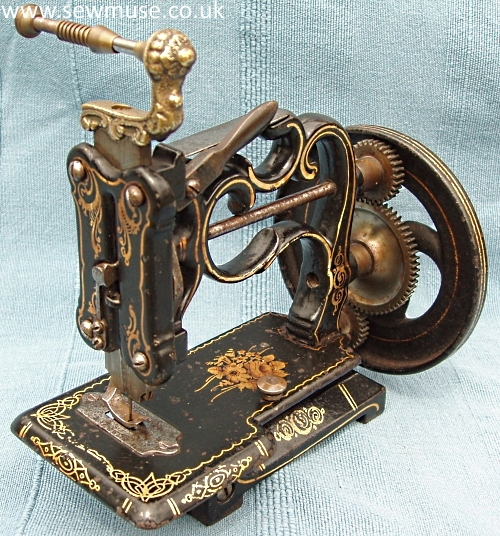
The American:
This is a Raymond's Family chain-stitch machine which dates to the late 1860's. It was sold by James Weir as The American Hand Sewing Machine and has Jas G. Weir stamped on the needle-plate together with Weir's shop address 2 Carlisle Street London.
I have only come across two other examples of this early design sold by Weir and would be interested in obtaining any advertising material showing this particular version.
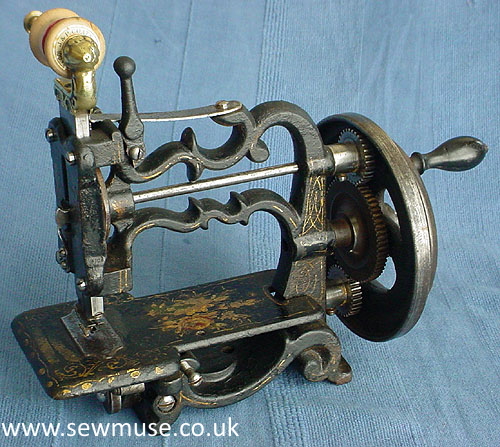
The Globe
This is an example of The Globe probably produced by Weir at Ferdinand Place, London.
The basic design is exactly the same as the machine shown above however it is later and has some minor differences note inparticular the base, with its scroll and boss for the table clamp instead the base being cast as a solid lump. The other obvious change is the presser foot lever, which has a ball end and the design of the lower arm has changed.
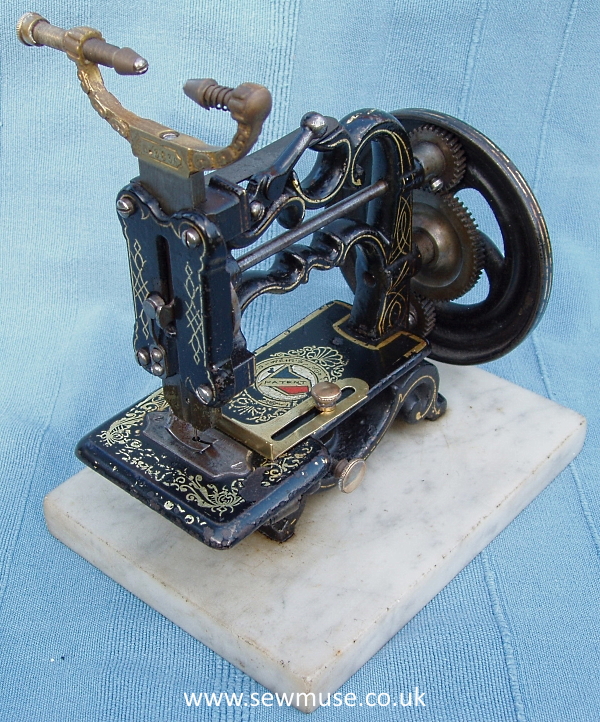
Weir's 55s
This machine is the improved version of the 55s machine and has the patent intermedial tension, silent spiral gears, safety stitch regulator, improved needle slide and oiling holes. The firm advertised that these improvements could also be applied to its earlier machines.
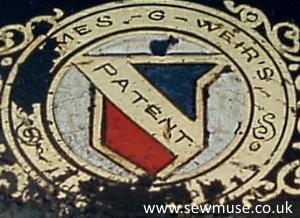
Like the Globe all Weir's 55s machines had Jas G Weir 2 Carlisle Street Soho Square London stamped on the needle-plate but in 1873 Weir's own Trade Mark was also japanned on the work plate of the improved machine.
The Marble slab which was to provide additional stability when sewing is an uncommon feature and is attached using a single screw into the bottom of the machine.
The U shaped reel holder has E3236 stamped into it which I suspect is the machines serial number.